
by Brent Price - Posted 7 months ago
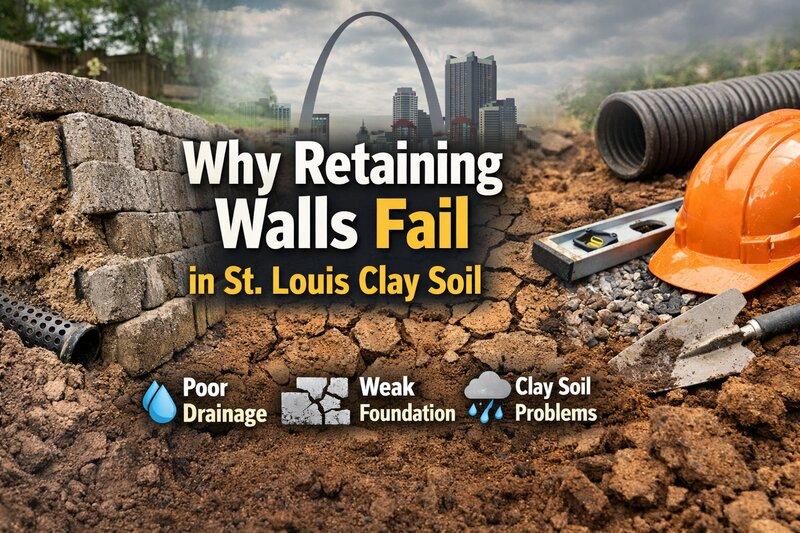
Retaining walls are one of the most valuable structural upgrades you can add to a property in St. Louis County. They prevent erosion, manage elevation changes, improve drainage, and create usable outdoor space. But in our region, not all retaining walls last.
The reason is simple: Missouri clay soil. In areas like Ballwin, Kirkwood, Manchester, Oakville, and Webster Groves, the soil composition creates expansion, contraction, and hydrostatic pressure that can destroy poorly built walls.
At Sandy Creek Landscaping, we design and install retaining walls specifically for St. Louis soil conditions. Understanding why walls fail is the first step toward building one that lasts decades.
Much of St. Louis County sits on dense clay-based soil. Unlike sandy soil that drains quickly, clay retains moisture. When it becomes saturated, it expands. When it dries, it contracts.
This constant expansion and contraction places pressure behind retaining walls. If the wall is not engineered correctly, you may see:
Many retaining wall failures in West County are not material failures. They are installation and drainage failures.
The most common cause of retaining wall failure in St. Louis County is hydrostatic pressure. This occurs when water builds up behind the wall and has nowhere to go.
Clay soil slows drainage. During heavy rains in areas like Crestwood and Ellisville, water saturates the backfill and pushes against the wall structure. Without proper drainage systems, pressure increases until the wall shifts or cracks.
A properly built retaining wall must include:
Skipping these steps to reduce cost almost always leads to premature failure.
The foundation beneath a retaining wall is just as important as the wall itself. In Missouri clay soil, excavation depth and compaction are critical.
If the base is not properly compacted and leveled:
In neighborhoods throughout Manchester and Town and Country, we often see walls built on insufficient base material. Over time, this leads to visible leaning.
Professional retaining wall construction in St. Louis County requires excavation below frost line considerations and proper compacted aggregate base layers.
Not all retaining walls are designed to handle clay soil pressure. Some decorative block systems are intended for low-height garden walls only.
In areas with slope challenges like Kirkwood and Ballwin, structural segmental block systems with reinforcement grid may be required. Taller walls may need engineered solutions.
Installing a wall system without evaluating soil load, slope angle, and water movement is a major cause of long-term failure.
Drainage and retaining walls are directly connected. In St. Louis County, spring storms and summer downpours can overwhelm properties that lack proper grading.
Common drainage issues include:
When we install retaining walls, we often evaluate whether drainage installation should be integrated into the project to protect the investment long term.
Homeowners in Oakville, Affton, and Mehlville should watch for early warning signs:
If caught early, retaining wall repair may be possible. If structural integrity is compromised, replacement may be necessary.
You can learn more about our retaining wall construction services in St. Louis County and how we design walls built for our soil conditions.
Retaining walls are structural systems, not just decorative features. In clay-heavy regions like Webster Groves and Ellisville, professional evaluation prevents costly mistakes.
At Sandy Creek Landscaping, we:
Cutting corners on retaining walls may save money upfront but often results in major repairs within a few years.
We build retaining walls throughout Ballwin, Kirkwood, Manchester, Crestwood, Oakville, Town and Country, and surrounding communities. Each neighborhood presents different grading and soil challenges.
Local knowledge makes a difference. Understanding how West County soil behaves through the seasons allows us to construct walls that hold up under pressure.
1. Why do retaining walls lean over time?
Leaning is usually caused by hydrostatic pressure from poor drainage or an improperly compacted base. Clay soil expansion makes this worse in Missouri.
2. How long should a retaining wall last?
A professionally installed retaining wall in St. Louis County can last 20 to 40 years or longer when proper drainage and reinforcement are included.
3. Can a leaning retaining wall be repaired?
Minor movement may be repairable. Significant bowing or structural failure often requires replacement to ensure safety.
4. Do retaining walls need permits in St. Louis County?
Permit requirements depend on height and location. Taller walls may require engineering approval. A professional contractor can guide you through local codes.
5. What is the best material for retaining walls in Missouri?
Segmental concrete block systems with proper reinforcement are popular due to durability and strength against clay soil pressure. Natural stone can also be effective when engineered properly.
If you are seeing signs of retaining wall failure or planning a new installation, fall and early spring are ideal times to address structural concerns before heavy seasonal rains.
Call Sandy Creek Landscaping at (314) 698-1228 or visit saintlouislandscaping.com to schedule a retaining wall consultation in St. Louis County.
When it comes to clay soil and structural integrity, experience matters. Let’s build it the right way.

Proudly Serving Missouri
Links
Follow Us
This page has been visited 0 times since April 11th, 2026
Sandy Creek Landscaping has been visited 168,447 times.
